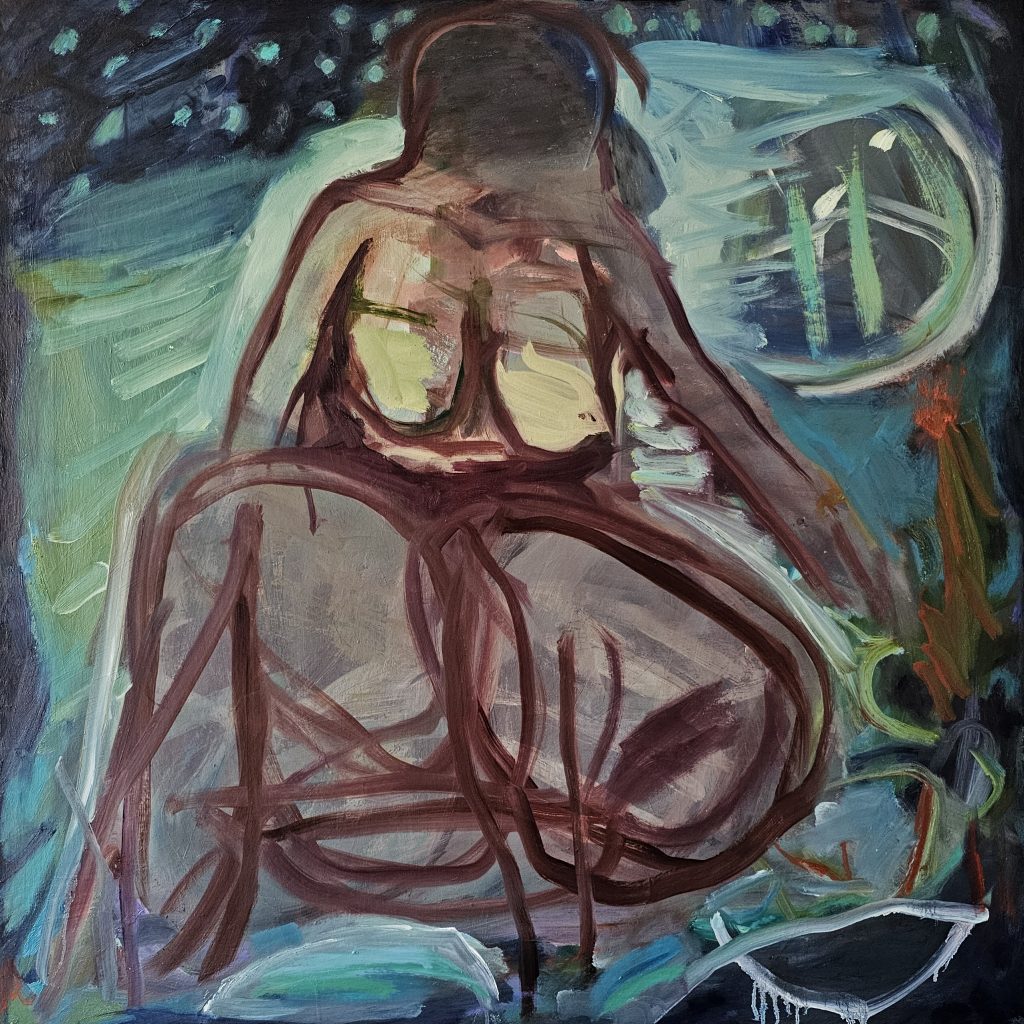
Oil on canvas, 100 x 100cm
Such a Deathly Desire
Painting Klossowski’s phantasm: a dark feminine economy of desire
Such a Deathly Desire brings together a new body of work by London-based painter Kelly Rose, working at the intersection of abstract expressionism, figuration, and continental philosophy.
Rose’s paintings enact rather than illustrate. Working through an automatic instinctual process, the canvas becomes a site of libidinal economy in the Lyotardian sense – a field of intensities that precede rational organisation. Figures emerge and dissolve within chromatic fields that refuse resolution: the mark-making performs an economy without guaranteed return, a release of energy that does not serve representation but exceeds it.
Pulsing through the work is the current of the dark feminine – specifically the archetypes of Lilith and Inanna: figures of exile, sovereignty, passion, and war. Rose is emphatically uninterested in the feminine as nurturing or maternal. These are forces, not comforts: what Nietzsche called ‘a pessimism of strength’ – a Dionysian surplus that overflows, seeking discharge precisely because it cannot be contained. Lilith’s refusal of subjugation and Inanna’s descent and triumphant return frame a vision of femininity as excess, as destabilising power – that which cannot be recuperated or domesticated back into acceptability.
Alongside Lyotard, the work draws deeply on Pierre Klossowski’s writings. His notion of “living currency” – the human body as a unit of affect that can refuse its own exchange value – informs the way Rose’s painted figures hover at the edge of legibility, never fully delivered to the viewer’s gaze. The blank painted face becomes the vehicle through which the phantasm demands a body: a mute, obsessive tableau in confrontation with the spectator.
The exhibition’s title is taken from Klossowski’s Un si funeste désir (Such a Deathly Desire), an essay collection developing, among other threads, Nietzsche’s eternal return – a title borrowed from Virgil’s phrase for the souls at the banks of Lethe who long to forget and be reborn into new, corruptible bodies. That same desire for descent into matter, and return, is the structure of Inanna’s myth – a queen who descends to the underworld, is stripped of everything, and rises again. In Rose’s hands, the female body becomes an avatar of this impulse: the dark feminine as refusal and return, embodying a justice that instead of balancing the scales, burns them. An overcoming that seeks no external justification.
Painting, here, is not representation but a transmission of desire. The erotic charge of the work lies not in what is shown, but in what is expended, obscured and withheld. In these canvases, transgression and taboo are not gratuitous; they are a method of personal ontological revelation. The medium of paint serves as a Lyotardian tensor, conducting sensations and desires, encoding sex and death into a single, irreducible charge.
What is a phantasm?
*For readers new to the term
Not a ghost, and not quite a fantasy. In Pierre Klossowski’s sense of the word, a phantasm is an image that arises from the body’s own drives, uninvited and involuntary – closer to an obsession than a daydream. You don’t choose a phantasm; it seizes you, and returns again and again, regardless of what you’d rather be thinking about.
The trouble is that a phantasm has no fixed form. It exists only as an intensity, a pressure, a charge – language or a picture can never quite catch it. So the person who carries a phantasm can only ever approach it sideways: through repeated attempts to give it shape and form, none of which ever fully succeed. Klossowski called these attempts simulacra – stagings, versions, disguises. Each one is inadequate and also the only way the phantasm can be seen at all.
This is different from illustration. An illustration depicts something that already has a clear form elsewhere – a scene from a book, a face from a photograph. A simulacrum of a phantasm does the opposite: it’s the first and only place the thing takes shape, because outside of that staging, it doesn’t exist as an image at all. It exists only as pressure, waiting.
This is why the paintings in this exhibition don’t set out to depict Lilith or Inanna (or whomever) the way an illustrator might depict a scene from a myth they already knew. The figures are staged, dissolved, restaged – approached again and again because no single version could ever be adequate to what’s driving them. The obsessive, repeated motifs are not a stylistic choice sitting on top of the subject. They are the subject: a phantasm, circling, insisting on a body it can never fully occupy.
About the artist
Kelly Rose studied Fine Art at Goldsmiths, University of London (as Kelly Tomkins), where she was immersed in the continental tradition that continues to ground her practice. She holds a Foundation Diploma in Fine Art from Hackney Community College, London, and prior to that undertook printmaking and life drawing at the Royal Drawing School (formerly The Prince’s Drawing School) over several years. Following Goldsmiths, she withdrew from exhibiting for an extended period of independent study and lived research – a sustained, unconventional apprenticeship in the very forces that now animate her painting: the dark feminine as a principle of sovereignty and resilience, and the Nietzschean conviction that life is justified only as an aesthetic phenomenon. Working through an automatic, instinctual process, her canvases stage a libidinal economy in which figures emerge and dissolve, conducting intensity and desire rather than representing it. Such a Deathly Desire is her first solo exhibition since returning to the public sphere. She lives and works in London.
https://www.instagram.com/karose222/ @karose222
https://substack.com/@karose222
© Kelly Rose, 2026